Kobold Rangers
Vainqueur the DragonThe Kobold Rangers are a kobold military unit whose decisive significance lies in their transformation of weakness into collective identity, discipline, and legacy. Initially presented as frightened creatures hiding in a basement, they become loyal minions of Victor Dalton, survive and contribute to battles, undergo supernatural evolutions, and eventually lead the wider minion forces of the Murmurin Empire. Their story gives institutional form to the claim that monsters dismissed as small and unremarkable can become legends through training, cooperation, and remembered service.
Identity and First Appearance
The Kobold Rangers first emerge from the basement as an apparent threat. The setting encourages an expectation of ordinary vermin, but the creatures are not rats; they are kobolds staging a deliberate entrance. Red, visibly larger than the others and functioning as their leader, directs the group’s choreography and insists that the performance be delivered with feeling so that Victor Dalton will be intimidated. The revelation culminates in their unified declaration of the group’s name, transforming a basement ambush into a theatrical introduction.
Their performance is both comic and purposeful. Rather than attacking immediately, the kobolds attempt to define themselves through costume-like coordination, a rehearsed pose, and a shared title. The name Kobold Rangers presents them as more than an assortment of weak monsters: it gives them a recognizable unit identity and implies a heroic tradition that they are trying to inhabit. Their self-presentation is therefore the first step in their later institutional development.
The theatrical confidence quickly gives way to a plea for employment. Red bows to Victor Dalton and asks him to accept the group as minions, while the other kobolds imitate him. They admit that they lack experience and that this would be their first minion work, but they emphasize that they are hardworking and versatile. This appeal places the Rangers within the emerging labor and command structure surrounding Vainqueur Knightsbane and Victor Dalton. Their importance begins not with established power, but with their willingness to submit themselves to a dangerous hierarchy in exchange for a role and the opportunity to prove their usefulness.
Service, Combat, and Evolution
The Rangers soon become active participants rather than decorative recruits. During a confrontation with François Vilmain, five kobolds leap from the fog behind the priest and seize his arms, legs, and head. They bite his flesh while shouting their allegiance to their sovereign, interrupting his spell at a crucial moment. The scene establishes the Rangers’ characteristic method: they compensate for individual weakness through coordinated action, surprise, physical commitment, and absolute group timing. Their intervention directly supports victory against a superior opponent.
That success is recognized by the Class System. Fearlessly leading monsters to victory against stronger enemies earns Victor Dalton seven levels in the Monster Squire Class, linking the Rangers’ battlefield performance to the progression of their commander. Their service therefore has consequences beyond the immediate fight. In the game-like economy of the world, the Rangers convert loyalty and collective violence into measurable advancement for the person responsible for leading them.
The unit also becomes a recurring part of Victor Dalton’s daily life. After leaving his bedroom, Victor finds three kobolds waiting outside alongside Jules Rapace, and the inn’s clients have already grown accustomed to seeing him bring monsters wherever he goes. This detail places the Rangers between military retainers and companions: their presence is operationally normal to Victor, while it remains socially conspicuous to the human surroundings. Their visibility helps normalize the movement of monsters through spaces once governed by human expectations.
The Rangers’ bodies are not fixed. After some of Victor Dalton’s kobold minions die, the system announces that they have been revived as Kobones. Their continued service thus includes an undead state rather than ending at death. This transformation changes the meaning of their loyalty: they can remain part of the unit after bodily death, and the Rangers’ identity becomes more durable than the original biological lives of its members.
Victor’s Mook Promotion Perk later reveals a hierarchy within the group. He senses that the perk can work on Red and on a mimic, but not on the other kobolds. The likely explanation is that Red has accumulated more combat experience as the leader and has consequently fulfilled hidden conditions, whereas the other kobolds have not. Red’s superior status is therefore not merely symbolic. Leadership, experience, and advancement are translated into different possibilities for evolution.
When Victor Dalton pats Red on the head and takes Junior from Blue’s hand, touching both creatures activates the perk. A bright light swallows them, and they transform. The moment combines affection, command, and mechanized progression: a familiar gesture becomes the trigger for a formal change of status. Red’s promotion is especially significant because it confirms that the Rangers’ leader can cross a threshold unavailable to most of the unit.
Command Structure and Imperial Role
The Rangers eventually become part of a much larger minion administration. After Vainqueur Knightsbane’s Bragging Day leaves the surrounding area devastated, the Kobold Rangers, gnolls, mimics, and other servants rush to his side when he declares that the celebration is over. Their presence in this aftermath shows them operating as a dependable organized force rather than as isolated followers. They are among the first bodies summoned when the dragon’s household must shift from spectacle back to work.
Vainqueur Knightsbane then assigns the Rangers responsibility for leading the minions on subsequent missions. The order is a major institutional promotion: a group that once begged Victor Dalton for its first minion job is now trusted with the coordination of other servants. The Rangers answer with a formal declaration that they live to serve their Dragon Majesty, accompanied by a practiced pose. Junior the Mimic’s happy bark reinforces the unit’s distinctive blend of military ritual, theatrical branding, and monster companionship.
Their new authority comes with concrete administrative duties. Ranger Red is ordered to find Charlene and obtain quests, restoring the flow of assignments after the holiday. Ranger Pink is tasked with writing a new chronicle of the War of the Hoard, specifically an account of the defeat of Maure titled The Return of the Dragon, and distributing it to every home. The Rangers therefore govern both action and memory: Red manages access to future work, while Pink manages the public record of past deeds. Their service extends from battlefield command into recruitment, information, propaganda, and the production of imperial history.
The group also receives direct recognition from Victor Dalton. When Rally Minion activates, all minions’ statistics rise by one stage, and Victor immediately selects the minions eligible for promotion: ten gnolls and every Kobold Ranger except Red. He touches them in succession and declares that they are being given a pay raise. The exclusion of Red reflects his earlier advancement, while the mass promotion of the others confirms that the unit has developed enough experience to evolve collectively. Their status is presented simultaneously as biological transformation and workplace compensation.
Red’s Leadership and Collective Discipline
Red is the Rangers’ defining internal leader. From the first basement performance onward, he is larger than the others, directs their choreography, speaks for the group, and later receives specialized equipment from Victor Dalton: a musket and a rapier. Those weapons mark his movement from spokesman to armed commander. His authority is not based only on size or ceremony; it is reinforced by experience, promotion, and the trust placed in him to organize other minions.
That leadership is visible in a later training scene involving Rangers and Kobones. When the others bully Pink, Red intervenes and makes them stop. He enters carrying the musket and rapier provided by Lord Victor and asks why the work is taking so long. The scene presents command as both protection and discipline. Red prevents mistreatment within the group while also demanding efficiency, making him responsible for the unit’s moral conduct as well as its performance.
Red explains the purpose of their training through the trauma of the Event. He argues that the experience was deeply traumatizing and that the Rangers must train hard so that such senseless atrocity can never happen again while they are on watch. In invoking Lord Victor’s teaching that they are the elite of the minions, Red turns obedience into doctrine. The Rangers are no longer merely serving because they were accepted; they are cultivating a professional identity based on vigilance, preparedness, and responsibility.
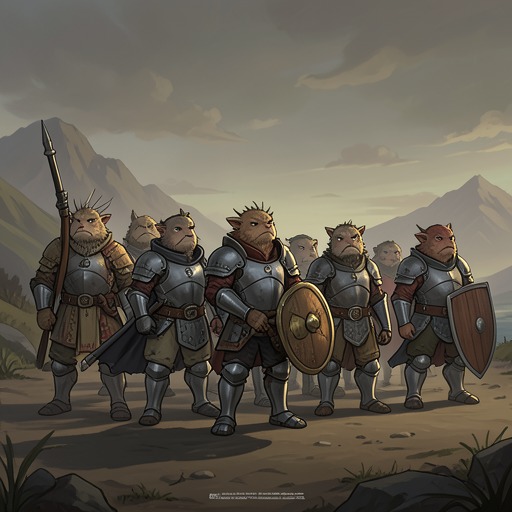
The unit’s combat formation demonstrates that this doctrine has practical consequences. The Kobold Rangers establish a defensive perimeter with Rolo’s fields of carrots and lettuces behind them. Yellow and Pink carry bows, Blue and Black use spears, and Red remains at the front with musket and rapier. The arrangement gives each member a clear tactical function while connecting military defense to the protection of food production. Their role is thus simultaneously imperial, agricultural, and communal: they defend the material base that sustains their society.
Even under physical strain, the group’s identity persists. After the fighting, Red looks over the team, observes that Blue has recovered, and notes that Yellow is struggling to put his bones back into place before asking whether the Rangers are all right. The presence of a member who must literally reassemble his bones underscores the unit’s undead continuity, while Red’s first concern remains collective welfare. The Rangers’ discipline is not abstract pageantry; it is expressed through checking the condition of comrades after violence.
Transformation, Legacy, and Narrative Role
The Rangers’ later self-understanding rests on a sharp contrast between their original condition and their achieved status. On their own, kobolds are weak, small, and unremarkable, and most die before reaching ten winters. Red’s argument is that this apparent insignificance need not determine their historical meaning. By learning ancient techniques preserved in the Apple of Knowledge and reviving the traditions of the Tokusatsu clan, the kobolds can become more than disposable creatures. They can become legends remembered by their kind for centuries.
This ambition gives the Rangers a form of collective immortality. Their lives remain precarious, since they may die at any time, but their legacy can survive them. The group’s military name, synchronized gestures, specialized weapons, training doctrine, and written chronicles all contribute to that legacy. The Rangers do not simply seek victory in the present; they seek a form in which future kobolds will celebrate what they became.
The culmination of this process is the explicit designation of the Kobold Rangers as the elite warriors of the Murmurin Empire. The title resolves the tension established at their introduction. They began as unknown basement creatures asking for a first assignment and ended as a recognized imperial force capable of defending territory and directing other minions. Their ascent is not presented as the erasure of their kobold nature. Instead, the very traits that marked them as marginal become the foundation for a new heroic tradition.
As characters, the Rangers function primarily as a collective protagonist with Red as its most individualized representative. Their repeated poses and slogans make them immediately recognizable, but the narrative also gives them development through combat experience, promotion, undead revival, changing equipment, internal discipline, and responsibility for imperial memory. They embody a recurring reversal in the story: the beings treated as expendable can become the ones who organize survival, preserve history, and define what counts as greatness among monsters.